Use nameplate HP and load factor instead of assuming full-load operation.
Energy savings guide
Compare old motor run hours against a premium-efficiency replacement path
Sustainability in motor rooms is often practical: identify continuous duty equipment, estimate annual hours, and decide whether IE3 Premium Efficiency is worth the replacement timing.
The review should not treat every installed motor the same. A lightly loaded standby pump may not justify the same analysis as a 24/7 fan, and a VFD-driven conveyor may need insulation and cooling review before energy savings become the leading topic.
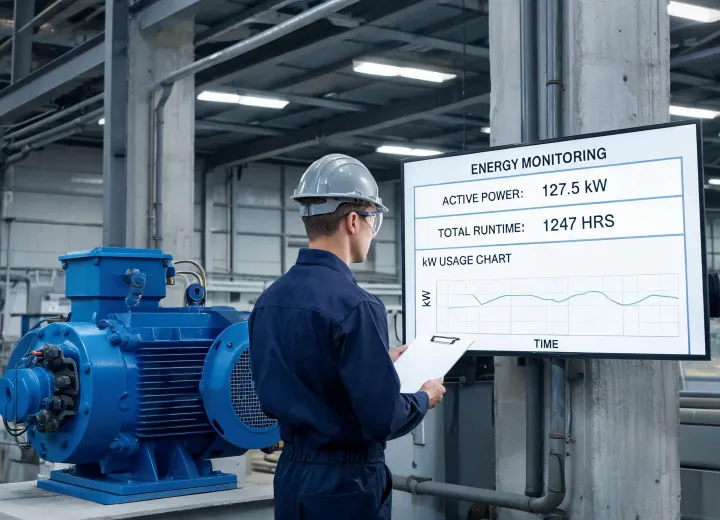
Calculator layout
Inputs that make a savings estimate credible
Continuous pumps and fans justify a deeper efficiency review than standby drives.
Compare documented efficiency values; do not use generic "high efficiency" language.
Drive operation, cable length and cooling affect the real selection, not just the utility math.
Use cases
Where premium efficiency conversations usually start
24/7 pump bank
A municipal utility reviews continuous run hours and VFD operation before replacing aging general-purpose motors.
Distribution conveyor
A packaging site checks start frequency and frame compatibility before standardizing a replacement family.
Food washdown line
A plant balances cleaning exposure with efficiency targets, avoiding an energy-only decision.
Ventilation retrofit
A facilities team compares actual fan load, 1,800 rpm duty and annual runtime before setting an IE3 Premium Efficiency replacement priority.
OEM standardization
An equipment builder documents voltage, frame and enclosure choices so efficient motor options can be reused across future machine builds.
Severe duty process area
A process plant weighs energy use against vibration, bearing protection and corrosion risk before replacing older motors.
Estimate before replacing
Send HP, run hours and current motor details for a grounded savings review.
We will help identify whether a premium-efficiency path is meaningful for the duty cycle or whether another constraint should lead.
Useful inputs include current nameplate efficiency, annual operating hours, estimated load factor, utility rate, control method and any environmental condition that could change the enclosure or bearing protection decision.